lördag 21 april 2012

Avreglering


The way economies are organized and function is significantly the product of social choices, not the product of nature. Over the past thirty years we (society) have embraced a set of economic ideas that shaped economic arrangements – including the pattern of income distribution, the power of corporations and finance relative to labor, and the way in which the economy generates demand.

This shaping of economic arrangements was obviously driven by political forces acting on behalf of corporate and financial elite interests, but economic ideas also played a critical role. First, the ideas of mainstream economists provided justification for the re-shaping of the economy in ways that elite interests wanted. Second, mainstream economists put forward additional ideas that were picked up and incorporated into the policy project of corporate and financial elites. Third, the monopoly capture of economic discourse by mainstream economics served to exclude other competing economic ideas from making it on to the policy table, into classrooms, and into the public debate.
The implication of this view is the crisis is at a deep level the product of a flawed economic policy paradigm derived from a set of flawed economic ideas. Escaping the crisis means replacing that policy paradigm and the ideas from which it derives. That is a massive challenge involving both a political contest and an intellectual contest. We need to win both. One without the other will be useless. It is no good winning the political contest if you simply replace Tweedledum (hardcore neoliberals) with Tweedledee (softcore neoliberals). Likewise, it is no good winning the intellectual contest if you do not win the political contest to implement different economic policy ideas.


My argument is that around 1980 the U.S. adopted a fundamentally flawed economic paradigm. From 1945 through to the mid-1970s the U.S. economy was characterized by a “virtuous circle” Keynesian growth model built on full employment and wage growth tied to productivity growth. The political triumph of Ronald Reagan enshrined a new economic paradigm that abandoned full employment and severed the link between wages and productivity growth.

The new paradigm was fundamentally flawed. One flaw was that it relied on debt and asset price inflation to fuel growth instead of wages. A second flaw was the model of globalization which created an economic gash in the form of leakage of spending on imports (the trade deficit), leakage of investment spending offshore, and leakage of manufacturing jobs offshore. These twin flaws created a growing demand gap.

That is where finance enters the picture as its role was to fill the demand gap. Financial deregulation, regulatory forbearance, financial innovation, financial mania, and plain vanilla financial fraud kept the economy going by making ever more credit available, However, as the economy cannibalized itself by undercutting income distribution and accumulating debt, it needed ever larger speculative bubbles to grow. The house price bubble was simply the last and biggest bubble and was effectively the only way around the stagnation that would otherwise have developed in 2001.


There are many mainstream (orthodox) economists who have progressive values but they miss the big picture because their theory cannot accommodate it. Moreover, they can’t abandory for a host of psychological and sociological reasons. At the psychological level it would involve a devastating admission that they have been wrong; that they’ve been teaching their students a lot of nonsense for thirty years. n their theoAt the sociological level it would mean giving up the trappings of power and pay that go with their current intellectual monopoly because the paymasters of the system would quickly replace them with others.


That said, many mainstream economists are starting to admit income distribution has played a role in fermenting the crisis (you have to be willfully blind not too see it). Consequently, they are busy trying to incorporate income distribution into their narrative. However, they do so in a way that leaves their core theory about markets and market efficiency unchanged. Unfortunately, journalists and the general public cannot see this and are taken in by this tactic. One of the contributions of the book is it unmasks these obfuscations by showing how these stories don’t stack up and are inconsistent with the evidence.

Finally, this discussion shows why it is very important the general public be capable of distinguishing between “values” and “analysis”. If not, people risk being fooled by the rhetoric of progressive values that provides cover for policies that are actually conservative.

Thomas Palley


fredag 13 april 2012

Filosofi för psykopater


It is not hard to see why Rand appeals to billionaires. She offers them something that is crucial to every successful political movement: a sense of victimhood. She tells them that they are parasitised by the ungrateful poor and oppressed by intrusive, controlling governments.

It is harder to see what it gives the ordinary teabaggers, who would suffer grievously from a withdrawal of government … I wonder how many would continue to worship at the shrine of Ayn Rand if they knew that towards the end of her life she signed on for both Medicare and Social Security. She had railed furiously against both programmes, as they represented everything she despised about the intrusive state. Her belief system was no match for the realities of age and ill-health.

But they have a still more powerful reason to reject her philosophy: as Adam Curtis’s documentary showed last year, the most devoted member of her inner circle was Alan Greenspan. Among the essays he wrote for Ayn Rand were those published in a book he co-edited with her called Capitalism: the Unknown Ideal. Here, starkly explained, you’ll find the philosophy he brought into government. There is no need for the regulation of business – even builders or Big Pharma – he argued, as “the ‘greed’ of the businessman or, more appropriately, his profit-seeking … is the unexcelled protector of the consumer.” As for bankers, their need to win the trust of their clients guarantees that they will act with honour and integrity. Unregulated capitalism, he maintains, is a “superlatively moral system”.

Once in government, Greenspan applied his guru’s philosophy to the letter, lobbying to cut taxes for the rich and repeal the laws constraining the banks, refusing to regulate the predatory lending and the derivatives trading which eventually brought the system down. Much of this is already documented, but Weiss shows that in the US Greenspan has successfully airbrushed this history.

Despite the many years he spent at her side, despite his previous admission that it was Rand who persuaded him that “capitalism is not only efficient and practical but also moral,” he mentioned her in his memoirs only to suggest that it was a youthful indiscretion, and this, it seems, is now the official version. Weiss presents powerful evidence that even today Greenspan remains her loyal disciple, having renounced his partial admission of failure to Congress.

Saturated in her philosophy, the new right on both sides of the Atlantic continues to demand the rollback of the state, even as the wreckage of that policy lies all around. The poor go down, the ultra-rich survive and prosper. Ayn Rand would have approved.

George Monbiot

söndag 18 mars 2012

Filmtajm

Land monopoly is not the only monopoly, but it is by far the greatest of monopolies -- it is a perpetual monopoly, and it is the mother of all other forms of monopoly.
              Winston Churchill


Real Estate 4 Ransom from Real Estate 4 Ransom on Vimeo.

söndag 19 februari 2012

Omnis Vestri Substructio Es Servus Ad Nobis


"If the American people ever allow private banks to control the issue of their currency, first by inflation, then by deflation, the banks and corporations that will grow up around them will deprive the people of all property until their children wake up homeless on the continent their Fathers conquered...I believe that banking institutions are more dangerous to our liberties than standing armies... The issuing power should be taken from the banks and restored to the people, to whom it properly belongs."


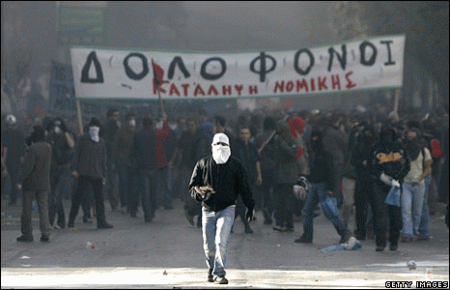
Greece became the stage for the fist social political explosion of the current world economic maelstrom because it is the weakest link, economically and politically, in the chain of the Euro-zone countries.

“All your base are servant to us”.

fredag 10 februari 2012

Brandkåren vs Polisen


Scener från Bryssel i Europa 2012.

Soldiers! Don’t fight for slavery! Fight for liberty!


I’m sorry, but I don’t want to be an emperor. That’s not my business. I don’t want to rule or conquer anyone. I should like to help everyone, if possible, Jew, gentile, black man, white. We all want to help one another. Human beings are like that. We want to live by each other’s happiness — not by each other’s misery. We don’t want to hate and despise one another.
In this world there is room for everyone. And the good earth is rich and can provide for everyone. The way of life can be free and beautiful, but we have lost the way. Greed has poisoned men’s souls, has barricaded the world with hate, has goose-stepped us into misery and bloodshed. We have developed speed, but we have shut ourselves in. Machinery that gives abundance has left us in want. Our knowledge has made us cynical. Our cleverness, hard and unkind. We think too much and feel too little. More than machinery we need humanity. More than cleverness we need kindness and gentleness. Without these qualities, life will be violent and all will be lost.
The aeroplane and the radio have brought us closer together. The very nature of these inventions cries out for the goodness in men, cries out for universal brotherhood, for the unity of us all. Even now my voice is reaching millions throughout the world — millions of despairing men, women and little children — victims of a system that makes men torture and imprison innocent people. To those who can hear me, I say — do not despair. The misery that is now upon us is but the passing of greed — the bitterness of men who fear the way of human progress. The hate of men will pass, and dictators die, and the power they took from the people will return to the people and so long as men die, liberty will never perish.
Soldiers! Don’t give yourselves to brutes — men who despise you — enslave you — who regiment your lives — tell you what to do — what to think or what to feel! Who drill you, diet you, treat you like cattle, use you as cannon fodder. Don’t give yourselves to these unnatural men — machine men with machine minds and machine hearts! You are not machines! You are not cattle! You are men! You have the love of humanity in your hearts. You don’t hate! Only the unloved hate — the unloved and the unnatural!
Soldiers! Don’t fight for slavery! Fight for liberty! In the 17th Chapter of St. Luke it is written: “the Kingdom of God is within man” — not one man nor a group of men, but in all men! In you! You, the people have the power — the power to create machines. The power to create happiness! You, the people, have the power to make this life free and beautiful, to make this life a wonderful adventure.
Then, in the name of democracy, let us use that power! Let us all unite! Let us fight for a new world, a decent world that will give men a chance to work, that will give youth the future and old age a security. By the promise of these things, brutes have risen to power, but they lie! They do not fulfill their promise; they never will. Dictators free themselves, but they enslave the people! Now, let us fight to fulfill that promise! Let us fight to free the world, to do away with national barriers, to do away with greed, with hate and intolerance. Let us fight for a world of reason, a world where science and progress will lead to all men’s happiness.
Soldiers! In the name of democracy, let us all unite!